
Humungous-sized Art: For Whom and Why

by Johny ML
Is there any relationship between Maharaja Ganga Singh and India's airports? Apparently, they are as dissimilar as Shreyas Talpade and the Malayalam language. However, through the high-ceilinged and capacious halls of Bikaner House, I have come to believe that the relationship is more than what our eyes can can see.
Maharaja Ganga Singh bought the plot for building his princely palace in the newly emerging British Indian capital, New Delhi, at the peripheral axis of the hexagonal end of the Central Vista, and got Bikaner House designed and built by the famous British architect Charles Geoffrey Blomfield. It was officially inaugurated on 18 February 1929.
Today, Bikaner House today is an art hub complete with six exhibition spaces, five-star lodging facilities, high-end eateries, a welcoming staff, and a lot number of lawns for evening gowns and egos.
Let me come back to the connection of this property with the airports. Of late, I have been seeing shows by some galleries that present certain artists with paintings of humongous size, perhaps as big as the halls. Art Alive Gallery's 25th year of existence is being celebrated with an exhibition titled 'A Moment in the Monumental', curated by Kishor Singh at the CCA Galleries of Bikaner House, and it has a few samples.
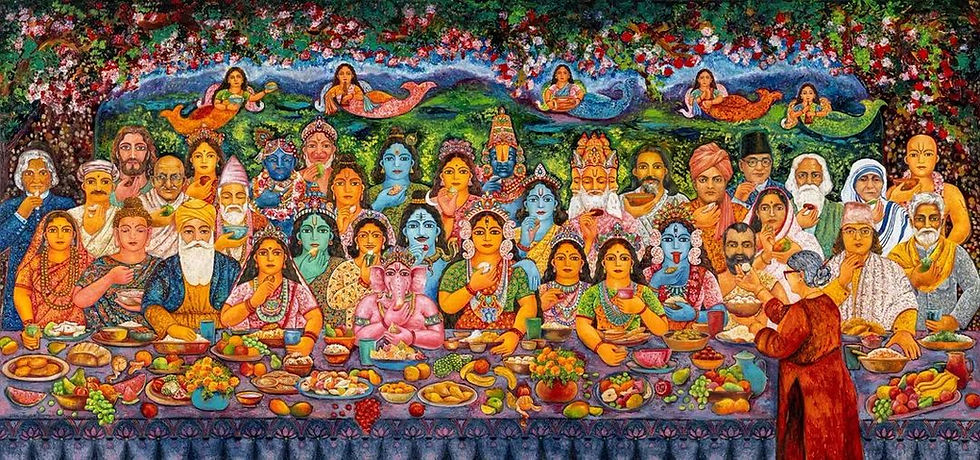
Jayashree Burman's Nivedya/Nivedan is 15 x 7 feet. And from the same family comes Arunodaya by Paresh Maity, sizing up to a spectacular 40 x 8 feet, perhaps the biggest artwork in the Indian gallery scene currently. Though there is a Krishen Khanna's Untitled canvas running into 56 x 5 feet, it looks less monumental than those by Burman and Maity.
One may wonder: why such size? Though we have seen War of Relics by K.G. Subramanyan (9 x 36 feet) and Ai Weiwei's Water Lilies (50 x 8 feet), and many other works at Nature Morte, Sakshi, and during certain a few editions of the India Art Fair, Bikaner House shows by some galleries provide an interesting case study.
Works of such humongous sizes are either collected for farmhouses, museums, or airport lobbies. Considering India's real estate status, very few could afford to have a 40- or 50-feet work placed in their drawing rooms. So, in India's case, the available spaces are the mushrooming airport lobbies that provide cavernous halls and walls running into miles.
And these big works do make a strong impression, especially in the current religio-political climate of our country.
Arunodaya by Maity may even cause a spontaneous and impromptu aarti, people breaking into bhajans and moderate spiritual gyrations with one eye on the flight time. It is not an improbable scenario, as we see people doing inflight and in-train bhajans and pujas.
Artists now have industry-standard studios complete with automated cranes and forklifts and an innumerable supply of BFA-degree-holding assistants. So, making a work of art of that size is not a problem. But the problem until 2015 was: where to exhibit?
Yes, Lalit Kala Akademi halls do have walls running into several feet, but it has never been an upmarket address for art. Shridharani only recently started the trend of nailing. In 2015, Bikaner House came, with a corporate address for art. It was almost at the same time that the Adani Group of Companies started taking over the ports and airports.
They needed art for beautifying the airports with swanky lobbies and walkways. Never before have we seen such huge big works in Delhi's art scene. And making big works is not a problem, and neither is getting them to the airport lobbies. Such moves should be appreciated. But have our artists stopped working on big or small pieces without thinking about their exhibition spaces or final abodes?
I have seen Anthony Gormley, Anselm Kiefer, and K. S. Radhakrishnan, and many others working on huge pieces without actually being commissioned by any agency or even without having an idea about their exhibition possibilities. If you think about the evolution of exhibition spaces in the West and elsewhere, from the posh white cubes with sanitized interiors and etiquettes to abandoned warehouses and other buildings, it was the idea of the curators and patrons or funding agencies to take them to unconventional spaces for want of polished interiors. Today, it has become a norm, but with some value-adding sophistication.
Look at how the Kochi Biennale turned around the practice of display by using then-disused properties like Pepper House and Aspinwall House. Now, many such properties are renovated and customized for art purposes. When Bose Krishnamachari curated Lokame Tharavadu, he used all those almost-abandoned former coir factory spaces for a large-scale show, where a long hall could accommodate Jitish Kallat's mile-long work of lunar eclipse. I am sure that Kallat did not create that work thinking that he would be presenting it in an abandoned space in Alappuzha, Kerala.
Maybe the new trend of making large works is for one large financial haul, I think, because the chances of these works coming back for auction houses look remote and unreal. It looks like an overkill. But definitely, big works do make big impressions! I do not discount that part of aesthetics. In a world of mindless enjoyment of reels and 3D ads coming on your dining table, short-term spectacularity of anything is a norm, and we have to live the times. No other way.
Before I close this rather long piece, I should mention Jayashree Burman's Nivedya/Nivedan. Done in oil on canvas, this work features 36 characters from history and mythology and five cherubs flying over them, bestowing them with heavenly blessings, while the artist's self-portrait, turned towards the facing figures, together makes the figures 42 in total.
Burman has done a 'Last Supper' act in an Indian way. If Da Vinci’s 'Last Supper' has some ominous premonition of betrayal, Burman's is an absolute celebration of Indian 'heritage' without much brain thought given to it other than the visual spectacularity that she is capable of creating.
First of all, given the way of the world in our times, she has bundled up Lord Ganesh, the triumvirate of the Hindu Pantheon—Brahma, Vishnu, Maheshwara—with the immortals from the mortal species like Mahatma Gandhi, Gokhale, Ghalib, Vivekananda, Sri Ramakrishna, and so on. But somewhere Burman gets ambitious and beckons all the lords possible, including Tirupati Balaji. And she feeds them all with a richly laid-out vegetarian meal and fruits for dessert. She does not even care that Swami Vivekananda was diabetic!
Burman echoes and references the pictorial traditions of textile labels of the 19th century, calendar art, and other popular images in culling and placing mythological and historical figures. The problem is that this painting is done in a country where political leaders claim Lord Ganesha underwent plastic surgery and Ravana flew a FlyDubai flight. In a silly arrangement, Jesus Christ, the main martyr of the original painting, is pushed to the back bench on the left corner of the painting, like a five-feet-tall boy in a school group photo.
Artists are supposedly the unacknowledged legislators of the world. They are the last woman standing against injustice. But Burman makes a Greek Salad of gods and historical figures, rendering Romila Thapar, Ramachandra Guha, William Dalrymple, Manu S. Pillai, Irfan Habib, Gita Kapur, and many other historians and art historians almost helpless. And the conspicuous absence of Dr. B.R. Ambedkar, Jyotiba Phule, and Savitribai Phule tells speaks loudly that, historically, it is a 'least supper' or a 'lost supper' work.
(This article by Johny ML was originally published on his Facebook profile. The text and image are republished here with the author's permission.)
……………………………………………………………………………………………………………………………………………………

Johny ML is a writer, translator, art historian, art critic, art curator, poet and a prolific blogger. His writings related to the arts, culture and politics have been published in several print magazines, newspapers and weeklies in English and Malayalam. He has also founded and edited many popular online art journals. One of the pioneering curators in India, he has curated high-profile group shows and camps throughout India. His blog is a platform for his continuous response to various issues he addresses within the art world, literature and a variety of other realms.
Johny ML lives and works between Trivandrum and Delhi.
(The views and opinions expressed by the contributors in their articles, features, and interviews on artamour are solely those of the individual authors/artists and do not necessarily reflect the views of artamour or its owners.)


Comments