
Transformation in Portraiture Over Time
- Ranjan Kaul

- Apr 26
- 6 min read
Updated: Apr 27
By Ranjan Kaul
The recent exhibition Portraits in Time presented by Great Banyan Art at Bikaner House, New Delhi (8–15 April 2026) reflected the evolving language of portraiture across geographies, histories, and sensibilities. The exhibition, comprising fifty paintings chosen from among the acquisitions of the Batra family over three decades, was a veritable exploration of the history of portrait painting – from academic realism to the expressive individualism of modern and contemporary art. The chronologically arranged portraits in the show ranged from the formal restraint of aristocratic portraiture to the introspective explorations of identity. What emerged sharply is how the advent of photography, shifts in patronage, and changing market structures have transformed portraiture, which has not only survived but has evolved with a defining presence of its own in the art world.
Responding to my questions on how portraiture has changed over time, its relevance today and in the future, Sonali Batra, the Curator of the show, and Director, Great Banyan Art, says:
“Portraiture feels especially relevant today because we are constantly creating images of ourselves, yet have rarely stopping to think about what they actually reveal. In a world shaped by selfies and instant visibility, the portrait offers a slower, more thoughtful way of seeing. Historically, portraits were about recording presence and status. Today, they are much more fluid, exploring identity, memory, and lived experience. They move beyond simple resemblance to ask deeper questions about how we see ourselves and how we are seen by others.
“Looking ahead, I think portraiture will only become more important. As images become more immediate and disposable, the portrait continues to hold meaning, offering a space for reflection in an increasingly fast and digital world.”


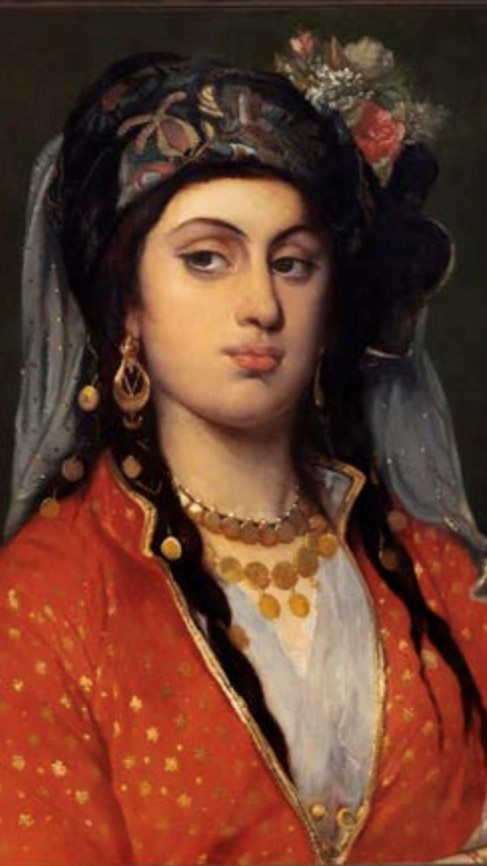
Left: Portrait of Maharaja Duleep Singh, oil on canvas, 37 inches x 26 inches
Right: Untitled (A Young Turkish Lady), oil on panel, 24 inches x 18 inches
The early European portraits on display – many of them by unknown artists of the Dutch, Italian, Spanish, German, and Danish schools – are distinguished by meticulous detail of shimmering jewellery and studied layers of fabric, while the subjects, moored within the upper echelons of aristocracy, sit composed and remote. In parallel, the show presented portraits of the royalty of the Indian courts – Awadh, Cooch Behar, Murshidabad, Travancore.
Indian artists, given their schooling in colonial art institutions, followed the principles of Western academic realism. The next generation of Indian artists, while continuing to be influenced by the modernist movement, also made attempts at indigenization. So, what emerged was a growing sense of individuality and expressiveness. This transition is especially palpable in the select works of modern Indian masters on display such as those by H.A. Gade, F.N. Souza, Rabin Mondal, Krishen Khanna, and Anjolie Ela Menon.


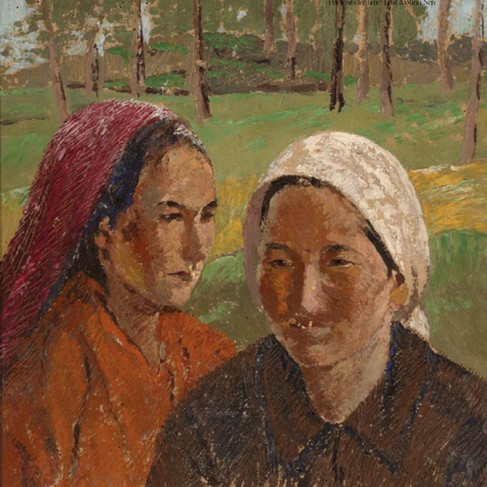
Left: Untitled (Depicting his daughter Usha Battish) by H.A. Gade,
oil on paper pasted on board, 17 inches x 19 inches
Right: Two Women in a Landscape by Lalit Mohan Sen,
oil on panel, 20 inches x 20 inches, c 1938
Gade mostly painted abstracted landscapes, and rarely did portraits, so it was gratifying to see the tender and intimate portrait of his daughter, Usha Battish. Shown leaning forward on an extended arm, the image exudes a quiet intensity, heightened by the flat tonalities of the angular form set against the dense backdrop of reds.
In Two Women in a Landscape Lalit Mohan Sen consciously goes beyond academic realism to incorporate traditional indigenous practices; he follows in the footsteps of artists such as Nandlal Bose who simplified forms and sought to dissolve the boundaries of their subjects and their surroundings.
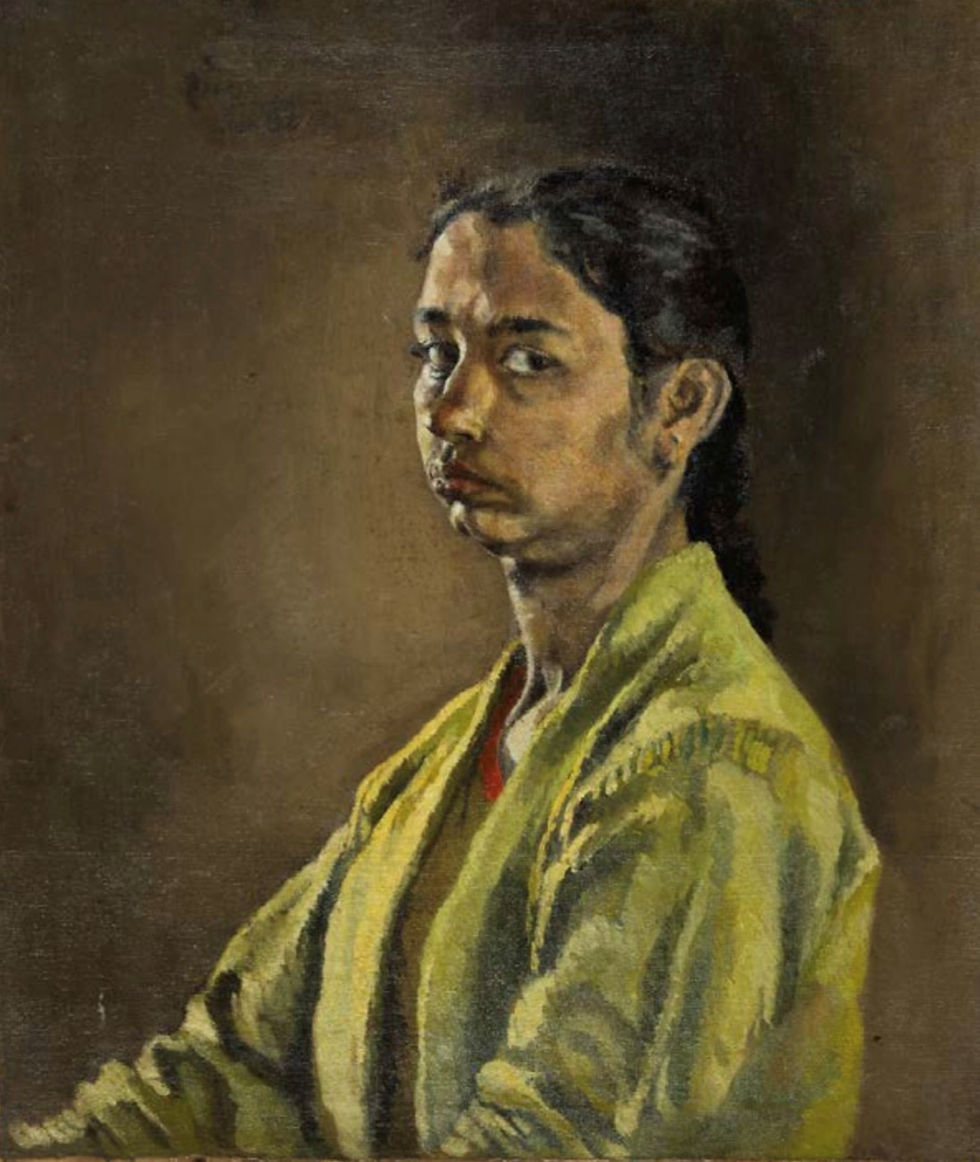
Shobha Broota’s early self-portrait, with its steady, unflinching gaze, asserts the artist’s presence not as subject alone but as consciousness, looking into the mirror and being observed at the same time.
Through their travels the Batra family acquired the works of several artists of foreign origin. Responding to my question about the criteria the Batra family employ for their acquisitions, Sonali Batra says, “When we look at acquiring a work, the starting point is always the strength of the piece itself. It needs to hold our attention, whether through its visual language, emotional depth, or the ideas it engages with. While factors such as the artist’s practice and relevance do matter, personal engagement remains key, as does how the work fits within the larger narrative of the collection. We think of acquisitions as part of an ongoing dialogue, where each work adds a new layer, deepens an idea, or opens up a different way of looking.”
Among the portraits in the exhibition was a striking late-nineteenth-century portrait attributed to L.Harris of a North African male, his blue turban contrasting dramatically with the red lapel of his coat. The departure from rigid academic realism with the use of loose and expressive brushwork lends the figure a vitality and immediacy. In contrast, Portrait of a Lady in Veil by British artist Madeleine Fawkes (1880-1954) looks inward, the lady’s identity drifting between revelation and concealment. The almost flat, raw umber background, subtle textures of the garments, and the delicately rendered left hand guides the viewer’s gaze towards her face. A similar inwardness characterizes the work of Spanish artist José Mallol Suazo (1910-1986). His Seated Figure, painted in a muted palette, evokes a moment of suspended contemplation. The economy of detail and soft texturing suggests a definite movement towards modernist figuration.


Left: Portrait of a Moroccan Gentleman Wearing a Blue Turban by L. Harris,
oil on canvas laid on board, 20 inches x 16 inches, late 19th century
Right: Portrait of a Lady in Veil by Madeline Fawkes, oil on canvas, 19 inches x 29 inches

The exhibition gathered animated momentum as it entered the terrain of modern and contemporary art practices by African, European, and American figurative artists. Male Portrait (1955) by Egyptian artist Ibrahim Shahda (1929-91) is an evocative example of expressive portraiture in psychological intensity. The saturated reds consuming much of the canvas generate an almost stifling atmosphere, while the dense and rough-hewn textures on the shirt impart a corporeal melancholy.


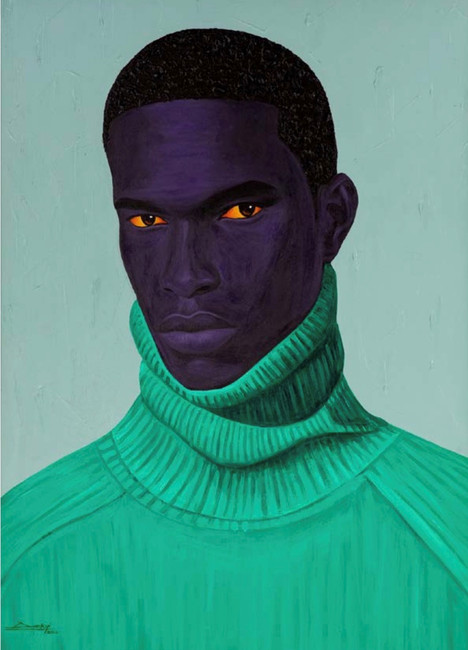
Left: Male Portrait by Ibrahim Shahda, oil on pastel, 21 inches x 30 inches
Right: Kumerican Muse by Dankyi Mensah, acrylic on canvas, 50 inches x 36 inches


American artist Franceska Schifrin’s Baboute’s Daughter is a picture of tenderness heightened by bold, contrasting coloration. The stylized figures of the mother rendered in bold whites and her child in a purplish red dress against a subdued green landscape makes for a touching narrative of care, protection, and intimacy. The child’s doll becomes an extension of this emotional world, a fragile, inanimate toy within the larger sphere of nurturing. Informed by her travels across Africa and Latin America, Schifrin’s work carries a cross-cultural sensitivity that resists easy categorization.
After Church by Nigerian artist Franklin Nonso Ndibam’s is a grounded and poignant portrayal of two companions, each carrying walking sticks, seated on the steps outside a church. Their coordinated attire and shared physical space suggest companionship; they do not look at one another nor do they talk, yet their silence speaks of a deeper, unarticulated bond held of quiet familiarity.
The works of Belarusian artist Pavel Bulva (b. 1991) explore the human condition. His arresting painting Three at Emmaus is a contemporary interpretation of the biblical narrative of Emmaus. Two figures sit across a table, yet are psychologically distant, each absorbed in their own interiority. The disparate objects on the table mirror their alienation, creating a subtle visual association between human presence and inanimate stillness, suggesting that proximity does not necessarily presuppose for closeness. Bulva’s expressive brushwork enhances this sense of disconnect.
Finally, Dankyi Mensam’s Kumerican Muse compels attention through the deep intensity of the subject’s gaze. The heightened yellow in the eyes, set against a face tinged with violet, creates a chromatic tension that is both striking and enigmatic. The vibrant green of the high-neck pullover contrasts with the softer pastel background to create an image that is at once contained and radiant, rooted in self-identity.
Taken together, Portraits in Time charts a stylistic evolution and deeper transformation in the very purpose of portraiture. While the commissioned realistic portrayals of the nobility look posed and impassive, the later modernist renderings are intense and emotive. Thus, what begins as an assertion of status gradually becomes an exploration of selfhood and identity – layered, fractured, intimate, open to interpretation. The exhibition reaffirms the significance of portrait-making in today’s age.
As Sonali Batra comments, “In a world full of images, the portrait asks us to pause and take a closer look.”
As it has evolved, a portrait is not about capturing a likeness; rather, it is a delicate negotiation between the artist and their subject, between appearance and essence, between the visible and the felt.
(All images are courtesy of Great Banyan Art.)

Ranjan Kaul is a visual artist, art writer and critic, curator, author, and Founding Partner of artamour. His works may viewed on www.ranjankaul.com and his insta handle @ranjan_creates.


The way the Batra collection traces portraiture from academic realism into expressive individualism really highlights how artists moved from capturing likeness to capturing inner worlds. I've been using a tool that helps break down these stylistic shifts https://ai-video-maker.net
The Batra family’s three-decade collection really captures how portraiture shifted from capturing likeness to expressing inner worlds. I’ve been using https://veo3-ai.pro
It’s fascinating how the Batra family’s three-decade collection traces portraiture’s shift from academic realism to expressive individualism. I’ve been using https://ai-logo-generator.com
Fascinating how the Batra family's three-decade collection traces portraiture's shift from academic realism to expressive individualism. I've been exploring similar transitions with https://yeggi.pro
The chronological arc from academic realism to expressive individualism in the Batra family's collection really highlights how portraiture mirrors shifting cultural priorities. I've been using https://ai-art-generator.org