
Ramani Mylavarapa: The Community-based Artist

In Conversation with Ranjan Kaul
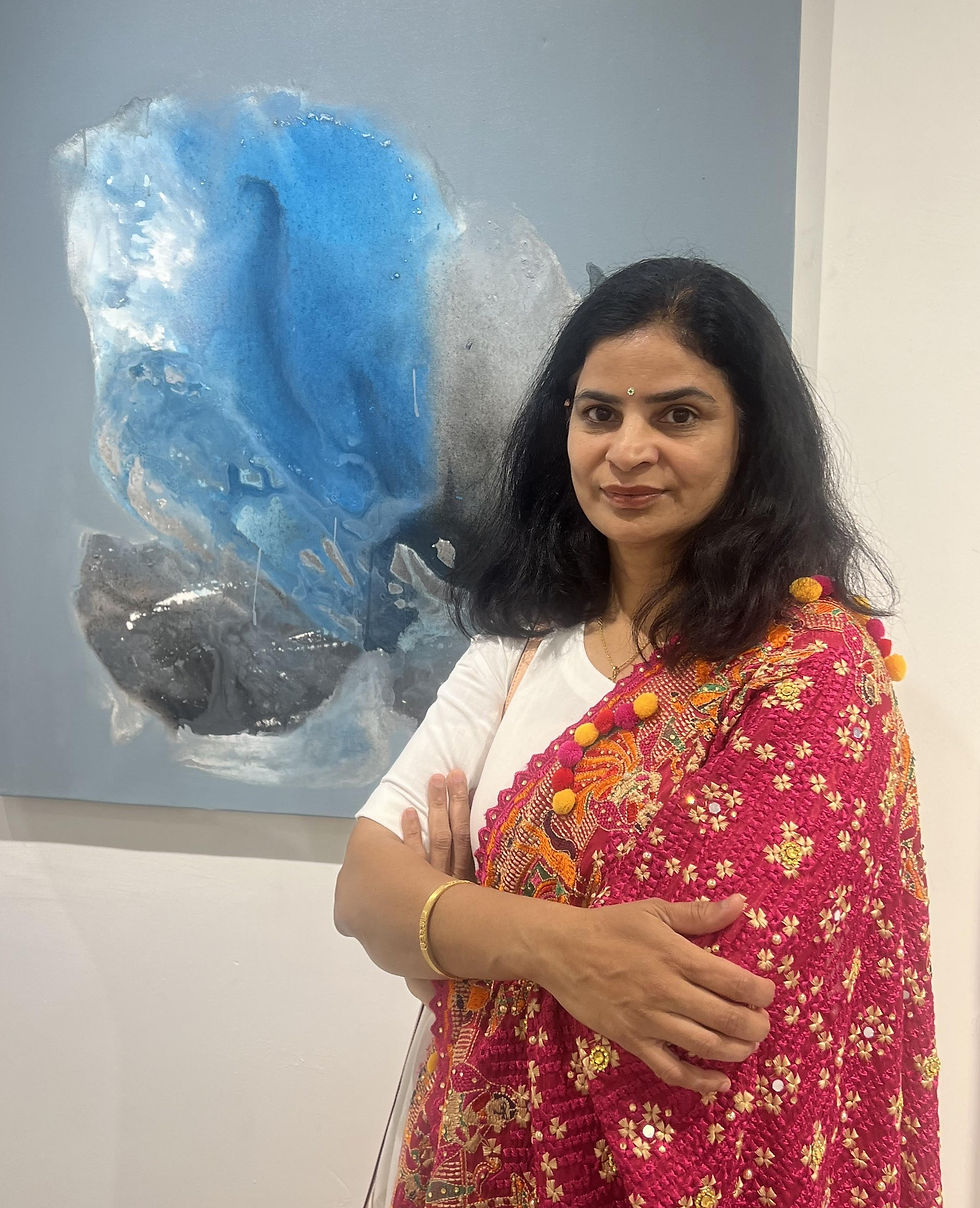
Ramani Mylavarapu is a multidisciplinary Indian artist working across painting, photo-performance, video, installations, and community-based art. A former fashion designer with a Master’s in Painting from Jawaharlal Nehru Architecture and Fine Arts University (JNAFAU), Hyderabad, and training from the Slade School of Fine Art, London, she explores culture, memory, feminism, and everyday life. Her long-term collaborations with tribes, fisherfolk, and farmers blend performance and photography, reflecting her deep engagement with nature and social narratives. She also runs the YouTube channel “Vedika–Ramani”.
Ranjan Kaul: From a fashion designer to a contemporary artist – how did it all begin? What prompted your shift?
Ramani Mylavarapu: I was always interested in painting and art since childhood, but it remained a hobby. Even in my fashion designing, I relied upon these artistic impulses and instincts. Over the years, my interest in art and painting grew, so I took a formal six-month art appreciation course at Chitrakala Parishath in Bangalore, a six-month certificate course in painting. I followed this up with more academic vigour and did a four-year BFA and subsequently a two-year MFA from JNAFAU along with a short-term summer course in contemporary art at the Slade School of Art.
I realized that I could express myself more deeply and directly in the visual art medium like painting and photo-performances, especially the ease with which I could express my concerns related to social causes and the underprivileged, particularly women.
RK: What inspires you to work with marginalized communities? How has this shaped your visual language?
RM: When we call them ‘marginalized’ we imply that these are helpless communities who are living on the edge and whose contribution is not considered. They even slip out of our consciousness. For many, they exist vaguely, and little is known about them.
As we battle the ecological environmental crisis in everyday life, I realized that these communities live closer to nature and follow simple, meaningful ways of life where peaceful co-existence with nature is a way of life rather than being in conflict. Working with tribes, fishermen, and farmers has taught me humility and respect for everyday labour.
When I spend time with them, I don’t go to them as an outsider – I try to become a part of their daily rhythm, stepping into their shoes, as it were. Their memories, stories, and rituals naturally enter my work. This has helped me to create a visual language based on metaphor, lived experience, and empathy. By giving visibility to their lives, my practice often becomes a form of gentle activism.
RK: What is your process of art creation? How has inserting yourself into your subjects changed you as a person?
RM: My process begins with observing, listening, and spending time with the people I work with. I photograph, perform, document, and later re-imagine these moments through installations, paintings, and photo-performance. When I insert myself into their world, I understand their emotions and struggles more deeply. This experience has changed me as a person – it has made me more grounded, patient, and aware of how connected we all are.
RK: What is the objective of your photo-performance and installation art? What do you wish to convey?
RM: Through my photo-performances and installations, I want to create a bridge between the viewer and the communities I work with. I aim to show their strength, dignity, and relationship with nature. My work is not just about documenting them but about inviting the audience to feel their presence, their labour, and their environment. Ultimately, I want to spark empathy and awareness.
Rather than only focussing on their poverty that is apparent, I could observe the optimism and zest for life that permeates their simple existence. It's this embrace of life that I capture in my photo-performances.


RK: Could you describe the themes of your earlier series? Why did you engage with Western art history at one point?
RM: My early works focused on women’s issues, especially during the #MeToo movement. I revisited European classical paintings and re-worked them from a feminist point of view. This helped me question how women were represented in Western art history and allowed me to insert my own voice into those narratives. Through photo-performances in my series ‘Real Heroes’ (2017) I also paid tribute to the India social reformers who fought for atrocities against women such as Raja Rammohan Roy, Gurajada Apparao, Kandukuri Veeresalingam Panthulu Garu, Savitribai Phule, Eswar Chandra Vidyasagar and Gandhiji. Remembering these leaders and their work towards women’s education and empowerment inspires me and gives me satisfaction. Later, my focus shifted to Indian communities with the series such ‘A Day in a Farmer’s Life’ (2019, 2020) during the Covid pandemic; ‘Invisible Roots’ (2023) working with the Araku Tribes; ‘Voices of Waves’ (2024) with the Uppada fishing communities, and recently the Bodo tribes of Bodoland (2025) which I exhibited in Bikaner House, New Delhi. Each of these series explores identity, labour, memory, and everyday rituals.


RK: Contemporary art is now multidisciplinary and socially engaged. Do you welcome this trend? Do you see it growing in India?
RM: Yes, I welcome this trend completely. Art today is not limited to one medium, and that gives artists the freedom to respond to changing social realities. In India, an increasing number of artists are moving toward installations, performance, and community-based practices as they search for newer mediums to convey their message.
I see this becoming stronger in the coming years, especially among younger artists who want their work to have meaning beyond the gallery space.
RK: Besides the visual arts, you are passionate about music, dance, and wildlife photography. How do you find time for all your interests?
RM: All my interests support each other. Music and dance give me energy, while wildlife photography connects me with nature. These activities refresh my mind and help me return to my art with greater clarity. I don’t see them as separate – they are all part of my creative life. I make time for what I love. I also find the time to perform at festivals in my community and direct short plays.
(All images are courtesy of the artist Ramani Mylavarapu.)

Ranjan Kaul is a visual artist, art writer and critic, curator, published fiction author and Founding Partner of artamour. His works may be viewed on www.ranjankaul.com and his Instagram handle @ranjan_creates.


Trump threatens in 999 new tariffs on European allies over Greenland until deal reached, as thousands protest
After Obama says they're real, Paglu Game Trump orders release of government files on UFOs
After Obama says they're real, Bharat Club Trump orders release of government files on UFOs
Trump threatens Sikkim game new tariffs on European allies over Greenland until deal reached, as thousands protest..
Trump threatens 66 lottery login new tariffs on European allies over Greenland until deal reached, as thousands protest